


Although the book has been out for a number of months, available for purchase and download, Coding Freedom finally has a dedicated home on the Interwebz. Based on my graduate research in anthropology and my dissertation, the book takes an up front and close look at various personal, affective, ethical and political dimensions of free software development. While the book is not on Debian per se, there is one chapter dedicated to the project and a whole lot of Debian developers were interviewed for the book. You can read some reviews and if you like what you see, take a dip.
February 21, 2013
Coding Freedom: The Ethics and Aesthetics of Hacking
February 6, 2013
Edward Tufte was a phreak
It has been so very long since I have left a trace here. I guess moving to two new countries (Canada and Quebec), starting a new job, working on Anonymous, and finishing my first book was a bit much.
I miss this space, not so much because what I write here is any good. But it a handy way for me to keep track of time and what I do and even think. My life feels like a blur at times and hopefully here I can see its rhythms and changes a little more clearly if I occasionally jot things down here.
So I thought it would nice to start with something that I found surprising: famed information designer, Edward Tufte, a professor emeritus at Yale was a phone phreak (and there is a stellar new book on the topic by former phreak Phil Lapsley.
He spoke about his technological exploration during a sad event, a memorial service in NYC which I attended for the hacker and activist Aaron Swartz. I had my wonderful RA transcribe the speech, so here it is [we may not have the right spelling for some of the individuals so please let us know of any mistakes]:
Edward Tufte’s Speech From Aaron Swartz’s Memorial
Speech starts 41:00 [video cuts out in beginning]
“We would then meet over the years for a long talk every now and then, and my responsibility was to provide him with a reading list, a reading list for life and then about two years ago Quinn had Aaron come to Connecticut and he told me about the four and a half million downloads of scholarly articles and my first question is, ‘Why isn’t MIT celebrating this?’.
[Video cuts out again]
Obviously helpful in my career there, he then became president of the Mellon foundation, he then retired from the Mellon foundation, but he was asked by the Mellon foundation to handle the problem of JSTOR and Aaron. So I wrote Bill Bullen(sp?) an email about it, I said first that Aaron was a treasure and then I told a personal story about how I had done some illegal hacking and been caught at it and what happened. In 1962, my housemate and I invented the first blue box, that’s a device that allows for free, undetectable, unbillable long distance telephone calls. And we got this up and played around with it and the end of our research came when we concluded what was the longest long distance call ever made, which was from Palo Alto to New York time-of-day via Hawaii, well during our experimentation, AT&T, on the second day it turned out, had tapped our phone and uh but it wasn’t until about 6 months later when I got a call from the gentleman, AJ Dodge, senior security person at AT&T and I said, ‘I know what you’re calling about.” and so we met and he said ‘You what you are doing is a crime that would…’, you know all that. But I knew it wasn’t serious because he actually cared about the kind of engineering stuff and complained that the tone signals we were generating were not the standard because they record them and play them back in the network to see what numbers they we were that you were trying to reach, but they couldn’t break though the noise of our signal. The upshot of it was that uh oh and he asked why we went off the air after about 3 months, because this was to make long distance telephone calls for free and I said this was because we regarded it as an engineering problem and we made the longest long distance call and so that was it. So the deal was, as I explained in my email to Bill Bullen, that we wouldn’t try to sell this and we were told, I was told that crime syndicates would pay a great deal for this, we wouldn’t do any more of it and that we would turn our equipment over to AT&T, and so they got a complete vacuum tube isolator kit for making long distance phone calls. But I was grateful for AJ Dodge and I must say, AT&T that they decided not to wreck my life. And so I told Bill Bullen that he had a great opportunity here, to not wreck somebody’s life, course he thankfully did the right thing.
Aaron’s unique quality was that he was marvelously and vigorously different. There is a scarcity of that. Perhaps we can be all a little more different too.
Thank you very much.”
August 1, 2012
Color Scheme Suggestions
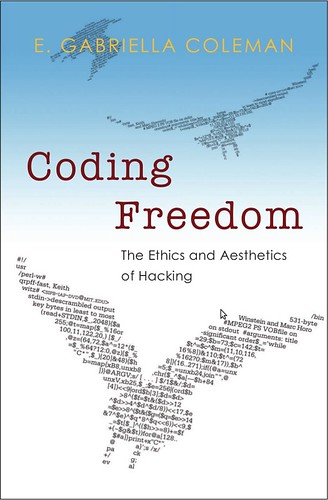
Ok here is the new (and final) cover:
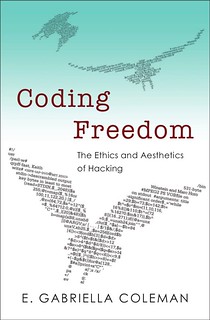
So I really like my book (on free software) cover but I am not convinced by the yellow/red color scheme. Any suggestions that would work with the beautiful blue background?
I am also going to suggest placing a black outline around the birds too as they blend a little too much in the background.
June 26, 2012
Engendering Change
I have always thought the question of gender in FLOSS far from simple … And so when I came across a peer review publication on the topic that made it too simple, I along with Christina Dunbar Hester — the real heavy weight of our piece — penned a response. It goes well with Jon maddog Hall’s moving piece coming out for Alan Turing’s 100th birthday.
February 18, 2012
Montreal, first impressions
When I told people of my plans to move to Montreal, it usually prompted one of two reactions: one was some version of joyful envy, many people exclaiming breathlessly “Montreal is one of my favorite cities,” one person once even clutching my arm and told me as he looked me straight in the eye: “you are so lucky, there is no city quite like Montreal in North America.”
The second reaction came off as a thinly veiled mixture of disdain and disbelief usually peppered with many “reallys:” “oh wow, really, really you would really leave NYC?” I am pretty certain they really were thinking something along the lines of “what a fool, how dare she leave a great job, a great university, a world class city (the only city to live) for some Canadian mid-sized city, which is like tundra for a good chunk of the year?”
The decision to move weighed heavily on me, if for no other reason I had a choice to stay or to go and I honestly have not had a “choice,” a decision to make about where to go since I got accepted to graduate school (and even then the choice was more obvious than this one). So over a month into my move what is my verdict? In a word, “win.”
I don’t miss NYC at all—though I get why some people cannot leave the place—and know that despite some oddities and difficulties of living in Montreal, it fits my tastes and needs much better than NYC which dwarfed me in so many ways. I never felt I could enjoy it, I grew tired of the cramped living quarters, the noise ate at my soul, and I simply felt more overwhelmed by the fact that I could not even get a handle on the neighborhoods in my vicinity, much less all the other hoods in the area.
Instead of dogging NYC anymore, I think I will spend a little time on first impressions, as they will soon be lost to the familiarity borne with time and experience. In essence Montreal is chock full of life but rather intimate, a quirky city with lots of charm but some grit and lacking the way over designed and done feel of cities like Portland.
Here are some of quirks:
1. The Hawt Metro: I fell in love with the Metro when I first rode it a few years ago. I just love the powder blue color of the cars and the super sweet 1960s aesthetic of many stations. Even better and unlike NYC, they are just clean and quiet. The downside? The temperatures approximates a sauna during the winter and while you would think this is a good thing, when you are layered with the clothing necessary to survive outside (re: long underwear along with Canada-coat, gloves, hat, and scarf), it is hooooooot down there and you feel like you need to pass out.
2. Spend money, get free stuff: In many establishments you get free stuff (like blueberries or some like sports bar) when you spend over a certain amount of money, like 70 bucks. Quirky local tradition.
3. The culture of negotiation and the kick ass standard lease: Housing is amazing here. There is plenty of it, there are many different styles, and it is rather fun exploring all the different hoods that make up the city. Problem is too that lots of apartments have weird problems and issues and I had to steer clear of anything that could even possibly have mold. I spent weeks day in day out looking for a place, desperate to move out of my corporate apartment very nicely provided by the university but still not my ideal living situation. Finally found a place that fit all my needs in the perfect location and I took it to only find out that places are priced to negotiate and I was faced with the decision to negotiate or not. Sort of did, was not thrilled about it (thinking that I might lose the place) but it sort of worked and I scored the place. If price is up to haggling, the lease on the other hand, is standard (you can buy one at your local bodega… ). It is the law to use it and it is like a no nonsense, straightforward lease, which is very protective of renters.
4. Montreal is known for its exceptional food but you know Poutine is just plain gross: Food here is good and I can tell that I will get a handle of restaurants in a way that felt impossible in NYC. The gluten free religion seems to be spreading, thankfully. There are many little Fruiterias! to get your fruits veggies which I am still exploring and right around my house is a crazy supermarket that is so cheap, which is weird because consumer goods generally ain’t cheap in Montreal like they are in the states but this place is a gem and everyone agrees (and almost impossible to notice from the street!). Now Poutine is disgusting. Ok it did not help that the first night I went out to eat it, I was still under the clutches of Noro virus, and I think it re-activated the nausea that had been zapped by some strong medicine and the hospital, the day before, which brings me to the next point, the health care system.
5. Healthcare, I had to use it way too early: So last week I came down with the Noro virus and you usually wait it out as it runs through you quickly but I was dehydrated before I even started to vomit to for 8 hours straight, at which point severely tired and so nauseous (I was yelling to make it stop), I went to the hospital. Now I had talked to lot of people about the healthcare system in Montreal as it seems good, really great but a bit over taxed, especially compared to where I had lived in Edmonton where it was like a magic fairy tale dream. I had heard of two things: the care is excellent but the facilities are “shocking” and the wait times unless dire can be atrociously long. So facilities, yea they are kinda shocking, somewhat shabby but who cares, so long as the care is good, no? Packaging is irrelevant so long as the goods are derived. Before going I was scared of the long wait times (and also the taxi took me by mistake to Montreal General Hospital was looked too much like a HUGE version of the creepy buildings in The Shining for me, and I was supposed to go to Jewish General so left for there). The wait time: nearly none, somewhat as shocking as the facilities first looked to me. I think it was a combination of the time I arrived, with the fact that my lounge was parched and yellowish-gross (sorry, it was gross), indicating I was dehydrated, oh and I was crying bit hysterically, for despite my high threshold for pain, nausea terrorizes me. I was covered by insurance and since I did not yet have my McGill health cards (it takes three months to qualify for the local stuff), I did pay and the price was laughably cheap compared to what I would pay in NYC for the same treatment.
6. Now for my favorite, snow so nice, ice oh Christ: Well this winter has been, by all accounts, weak and warm, the spirit of winter barely making its way from the underworld to the outerworld. But even though it is has been more idle than full throttle, I still got a pretty accurate taste of what winter is like, with a few days of 20- c temps, and having to walk a number of times on a layer of frozen ice that makes it feel like a very dangerous mini-ice age in the making.

I do rather love the quiet snow falling and just love love sprinting through the snow with my dog, Roscoe, who has taken a liking for prancing in the white stuff and looks awful cute with his winter man’s ice beard. After a sizable snowfall, it is clear they city does not toy with the snow removal although the sidewalk snow plows do look somewhat like very large and dangerous but kinda cute toys. But let’s be frank, winters are hard, so hard that I think I would go mad if I had to stay through the entire thing, being born and raised in the tropics… So the fact that I am writing this from the southern hemisphere in the height of summer gives me the assurance I can handle the rest of the snow, ice, ice and snow upon my return.
December 22, 2011
The Best of NYC

Now that the semester is done and now that I have compiled my crazy paperwork for Canada (wow, it is a lot), I will be heading in six days to the wonderful city of Montreal to settle down, at least for a few years.
I am ready to leave but it is not an easy move, as I like NYC and my job. I came to New York City for the first time at the age of 19 after spending a year on a ship and I rather did not like the city for those 5 years, although loved my college years and all the time I spent chasing a Frisbee while running on grassy fields all over the east coast. When I left in 1998, I said, ‘never again.” But the future is impossible to predict so of course I came back when I got a job, my only job, at NYU MCC and headed quite happily here (incidentally from Canada).
And NYC was much much much better the second time around, most likely as I had a salary, and here is what I <3 and loved about the city.
1. Not having a car (which will still be the case in Montreal)
2. The bike path on the Hudson, especially the gardens and the Irish famine memoriall
3. The farmer’s markets (won’t miss the prices though)
4. High walkability factor (and though I did not love my hood, I loved being 1.5 blocks from my office)
5. The music jam circles in Washington Square Park (I was always left wondering if they were spontaneously generated or long standing groups // prolly both) and the occasional but mighty impressive hawks in the park.
6. Coney Island especially under certain special conditions when you can rly enjoy the lights radiating out of the amusement park
7. Leaving the city for some nature time
8. 24 hour trains (despite not loving them cuz the noise robbed some life from me every time I took them)
9. Grand Central Station’s ceiling
10. The gluten free options (this is going to be the hardest to give up as Montreal sort of sucks in comparison)
11. Being able to take your small dog on the train  which is only a recent pleasure
12. My department
13. East Asian Starr library at Columbia University (still my favorite library in the world) and totally loathed NYU’s Bobst, ugly on the outside, ugly on the inside
14. NYC sunrises which I have like only seen 3 times (sadly) but they have been stunning every time
15. Walking across the Brooklyn Bridge
16. HOPE
17. The Highline
18. The Strand
19. My favorite thing = Massive Snow Storms in the City (good thing I am moving to Canada, eh?)

October 16, 2011
What a Hackable World?
I really don’t know what to make of this Cisco-made video “What a Hackable World.” It is sort of interesting that Anonymous and Lulzsec made it in but the video is not all that clever. And what up with the nerd-o-matic sys admin (most sys admin I know are more hoodie, less nerdie). But can anyone explain what/who the main featured dude is supposed to be? Hacker detective/destroyer? Cisco customer?
Going to São Paulo next week

First, is that image really the best LOLcat referencing Brazil that exists out on the Internets? I sure hope not as it is sort of lame but it was the only one I could find (in the 30 seconds I looked, which I admit, is not all that much time).
But all of this lolcat in Brazil stuff is really to say, I am heading to São Paulo tomorrow to give a talk on Anon on Thursday at this conference. If you are an Anon in the city and can make it, please do. If you are not Anon and are still interested, come along as well ;=)
If there are Debian developers as well in the city, it would be great to meet at some point. I am there from Tuesday morning to Friday night.
October 13, 2011
Jobs vs Ritchie
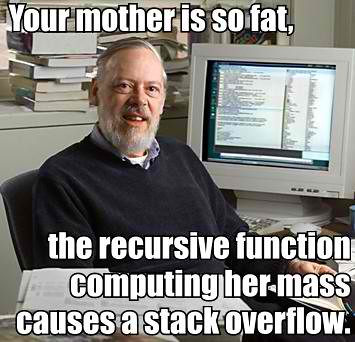
Best said here Let not make the final statement “and not a single newspaper cares”" into a reality.
PS: Do check out Against Nostalgia, a great jab at Jobs.
September 26, 2011
Now for the harder photo request: Free Dmitry!
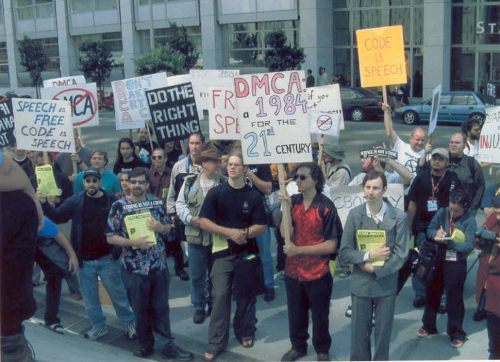
So one my favorite fieldwork photos is the one above and I would love to include it in my book but I have no idea where I got it from much less who took it. The photo was taken during a San Francisco protest against the DMCA, and more urgently at the time, also calling for the release of Dimitry Sklyrov (and we were all listening to Richard Stallman who was giving a small speech and I am on the right hand side of the photo, furiously scribbling notes)
I am looking for a high quality photo from one of the many Dmitry Sklyarov protests that were held in San Francisco or San Jose–a photo that is either under CC license or given to me with formal permission to publish (I have forms to get official permissions). As I mentioned in my previous post, the book will be published with Princeton University Press with a CC license.